
Why Building Costs in Australia Keep Rising — And What It Means for Your Project
April 1, 2026
April 1, 2026
Part 1 of 2 — Read Part 2: What Does a Modular Home Actually Cost in Australia?
There has never been a more important time to understand what drives building costs in Australia — and what you can do about it.
Since the start of the COVID pandemic, residential building costs in Australia have risen by more than 31% nationally. That is not a blip. It is a structural shift, driven by a combination of forces that are not going away anytime soon: chronic labour shortages, global supply chain disruption, geopolitical pressure, and a pipeline of public infrastructure spending that is competing directly with the residential sector for every available tradesperson.
For anyone planning to build in Australia — whether it is a home, a secondary dwelling, or an investment property — understanding what is happening in the market is the first step to protecting your budget.
What Is Actually Driving Building Costs Up in Australia
Labour — The Biggest Driver
The most significant and persistent cost pressure in Australian construction right now is labour. The industry simply does not have enough skilled tradespeople to meet demand.
According to CoreLogic, labour was the primary driver behind a 3.4% rise in residential building costs in Australia in 2024 — the largest annual increase since 2023. Looking ahead, industry analysts expect the pace to continue rising toward the pre-COVID decade average of around 4% per year.
The problem is structural. Tradespeople take years to train. Industry numbers have been declining for some time. And residential construction is now competing head-to-head with a record level of public infrastructure spending — roads, rail, hospitals — for the same pool of workers. Infrastructure Australia forecasts this labour mismatch will persist until at least mid-2028.
The practical effect: builders are pricing risk into every quote. Longer build times mean more exposure to building cost escalation. The average build timeline in Australia has blown out from the pre-COVID norm of seven to nine months to twelve to fourteen months today — and every additional month on a building site costs money.
Materials — A Mixed Picture With a New Threat
Material cost pressures eased through much of 2024 and early 2025, offering some relief after the extraordinary spikes of the COVID period. But that window may be closing.
In early 2026, major suppliers began notifying customers of significant price increases on essential building products — HDPE pipes and fittings up by as much as 36%, twinwall stormwater pipes up 31%, and PVC plumbing products up nearly 29%. Suppliers cited disrupted shipping routes and rising fuel costs linked to ongoing conflict in the Middle East as the cause.
Concrete continues to climb, driven by sustained infrastructure activity. Copper — embedded in every electrical and plumbing fit-out — is up 16.5% year on year, directly affecting the cost of the trades that finish every build. Even where material prices have stabilised, the flow-through from earlier increases continues to sit in builder pricing.
The Geopolitical Factor
Australia’s construction industry imports significant volumes of materials and relies on global shipping networks to deliver them. Conflict in the Middle East has added fuel surcharges across transport and logistics. The war in Ukraine has created ongoing pressure on steel and energy inputs. Anti-dumping scrutiny on imported steel products raises the prospect of targeted tariffs that could tighten local supply further.
These are not short-term shocks. The complex interplay between geopolitical tensions and global supply chain disruption is now a permanent feature of the building cost environment in Australia.
What Rising Building Costs in Australia Mean for You
The cumulative effect is significant. For a typical 200 square metre home, construction costs alone now range from approximately $380,000 to $780,000 depending on location, finishes, and complexity — before land, before approvals, before site works.
Budget blowouts are no longer an exception. They are a structural risk of the traditional on-site build model, where dozens of separate contractors are coordinated across an extended timeline, each bringing their own supply chain exposure, their own labour dependencies, and their own margin on top.
Cost certainty — knowing what you are committing to before you commit — has become the most valuable thing a building product can offer in Australia right now.
A Different Way to Build
This is the context in which factory-built modular construction makes the most sense — not just as a faster or greener alternative, but as a fundamentally more cost-controlled one.
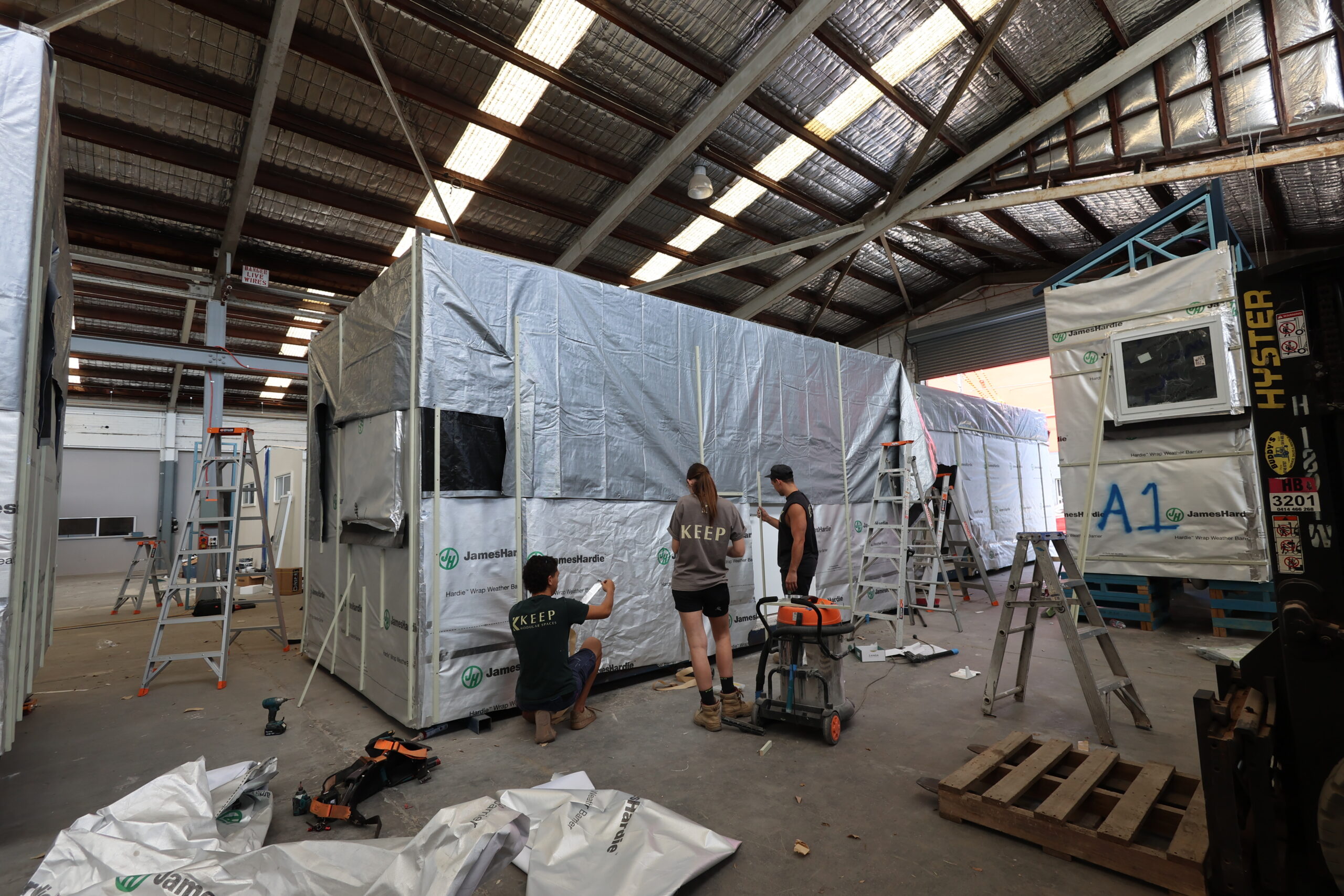
At Keep Modular, all trades come to us. Our Forma manufacturing facility in Croydon, Sydney is a single controlled environment where structure, fit-out, and finishes are completed to a fixed specification before the module leaves the factory. There are no separate contractors to coordinate on site. No weather delays stretching a twelve-week build into twelve months. No daily exposure to the fluctuating building costs that are reshaping the Australian construction market.
The Forma Series — our range of pre-designed modular homes — is built on this principle. Each product has a fixed layout, fixed specification, and a price that is known before you commit. That is not a marketing line. It is a design discipline built into the system from the ground up.
In a market where building cost unpredictability in Australia has become the norm, predictability is a genuine competitive advantage — for us, and for the people we build for.
What to Read Next
Understanding what drives building costs in Australia is one side of the equation. The other is knowing what you can actually expect to pay for a modular home — and what that price does and does not include.
Part 2: What Does a Modular Home Actually Cost in Australia? →
Or, if you are ready to talk about your project: Get in touch with the Keep Modular team
Sources: CoreLogic / Cotality Cordell Construction Cost Index; Altus Group Australian Construction Material Price Outlook Q4 2025; Australian Bureau of Statistics Producer Price Indexes; Master Builders Australia; Infrastructure Australia; RLB Oceania.
© 2026 Keep Modular. All rights reserved.
We’re located in Sydney on Gadigal land. We acknowledge the Traditional Owners of the lands across Australia, their diversity, histories, knowledge and their continuing connections to land and community. We pay respect to the Elders past, present and emerging for they hold the memories, the traditions, the culture and hopes of Aboriginal and Torres Strait Island people across the country.
An integrated modular building process —
from design to installation.


166 Parramatta Road
Croydon NSW 2132
+614 8550 9377
admin@keepmodular.com.au
ABN 53 152 554 151
NSW Contractors Licence 293035C
No spam. Occasional updates only.

Be the first to comment