
How Modular Construction Works in Practice — Keep Modular Q1 2026
May 5, 2026
What Our Q1 2026 Projects Prove About Modular Construction in Australia
Modular construction efficiency in Australia is no longer a theoretical argument — it is something you can observe on a sloped site in Cringila, measure in a one-day install in Sutherland, and plan around when you start a new project the same week the last one leaves your factory floor. Q1 2026 was the quarter that made that visible for us across five active sites.
Australia’s housing conversation in 2026 is loud. The National Housing Accord targets 1.2 million new homes by 2029. The modular construction market reached USD 11.8 billion in 2025 and is forecast to grow steadily through the decade. And on the ground, builders are being asked to do more — faster, across more varied sites, for a broader range of Australians — than at any point in recent memory.
We don’t often write about our own work. But Q1 2026 was a quarter that told a story worth telling — not as a company update, but as a live demonstration of what modular construction efficiency in Australia looks like when it’s working across rural sites, complex terrain, specialist accommodation, and a busy factory floor simultaneously.
Across five active sites and two significant product launches, here is what the projects proved.
Parallel Scheduling: The Core Efficiency of Modular Construction
The most misunderstood advantage of modular construction is not speed. It’s parallelism.
In a traditional on-site build, the sequence is fixed: foundations first, frame second, fit-out third. Each trade waits for the last. The timeline compounds. The average traditional build in Australia now runs twelve to fourteen months — and that’s before approvals.
Modular construction breaks the sequence. Site works and module fabrication happen simultaneously. By the time your slab is poured and your services are roughed in, your home is already taking shape in a controlled factory environment. The two tracks converge at installation — and the cumulative time saving is significant.
Our Q1 projects made this visible across three sites in a single quarter.
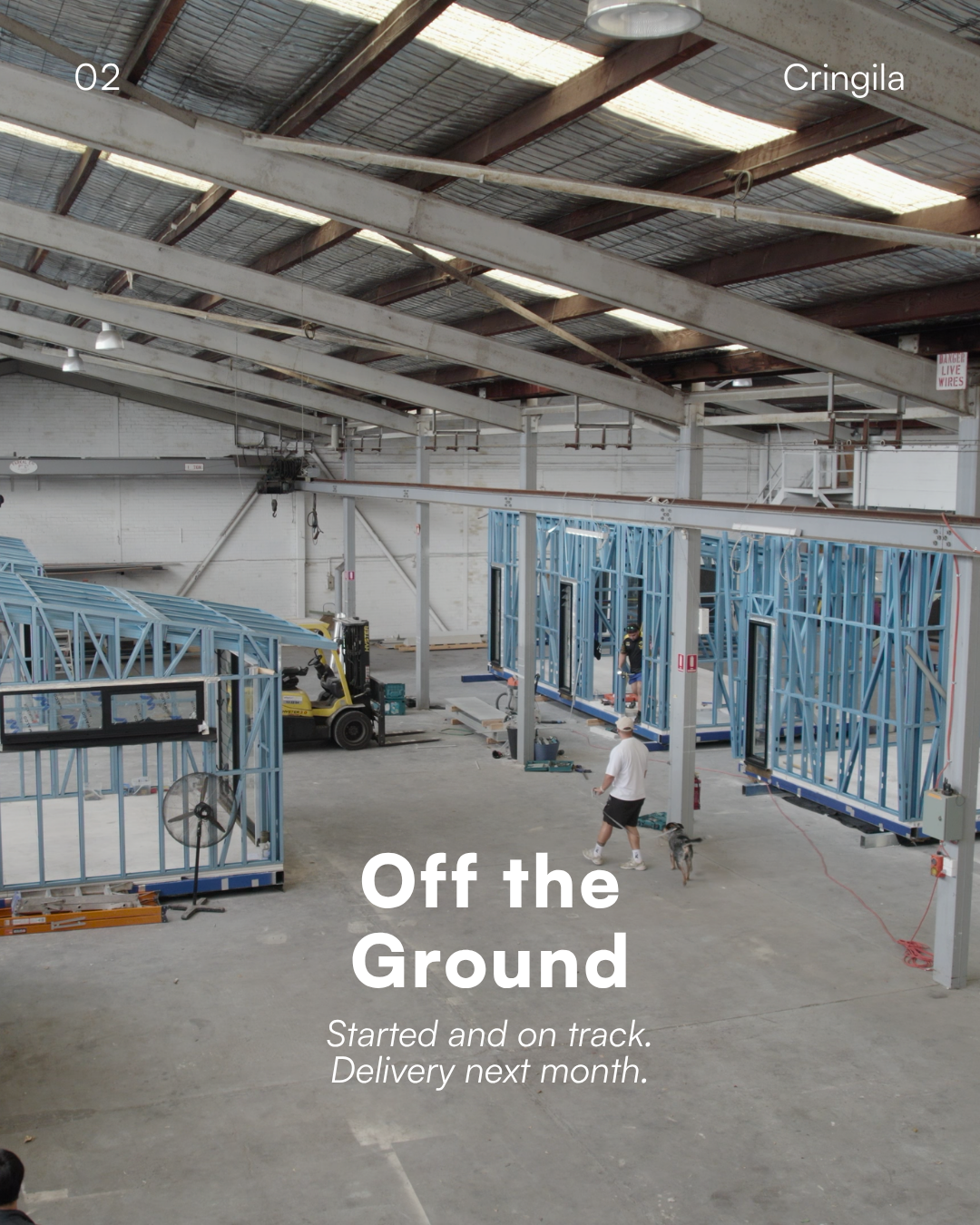
At Cringila, we were working with a significantly sloped site — the kind of terrain that adds weeks to a traditional build through retaining structures, extended concrete work, and the coordination overhead of trades working on an uneven platform. Our team managed the site preparation and module fabrication in parallel, with careful scheduling to ensure the site was ready to receive the modules as soon as the factory completed them. The slope that would have compressed and complicated a traditional build had no bearing on what was happening in Croydon.
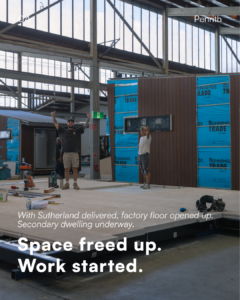
At Sutherland, the installation was completed in a single day. One day from module arrival to a weatherproof, structurally complete building on site. That’s not a headline figure — it is the practical outcome of doing the work in a factory first. The on-site phase is short because the hard work is already done.
The Sutherland install also demonstrated something operationally significant: as soon as the modules left the factory floor and the installation crew headed to site, we were able to redirect factory capacity immediately. Work began on the Penrith project the same week. That rhythm — install, free capacity, start the next — is only possible because the factory and the site are decoupled. In traditional construction, your builder can’t start the next job until your job is finished. With modular construction, the factory runs ahead of the site. Multiple clients benefit simultaneously.


Rural Sites: Modular Construction Efficiency in Australia Beyond the Metro
One of the persistent misconceptions about modular construction in Australia is that it suits urban infill and not much else. Cringila and Sutherland sit within the greater Sydney and Wollongong regions. Bathurst sits 200 kilometres west of our factory.
The Bathurst project expanded what we’d demonstrated before. It was a hybrid volumetric build — a model that combines our factory-built modules with complementary on-site construction elements — and it was delivered as a Specialist Disability Accommodation (SDA) Robust duplex. Two dwellings. One site. Our first of its kind.
SDA is a federally regulated category under the NDIS. Robust-class SDA has specific and demanding design requirements: reinforced wall construction, impact-resistant finishes, stronger structural connections, and layouts engineered around the needs of residents with complex physical and behavioural support requirements. It is not a minor variation on a standard residential build. It is a distinct and technically demanding product — and delivering it as a duplex adds another layer of coordination.
The Bathurst project proved that our factory-built system can meet those requirements — and that we can do it on a rural site, at distance from our Croydon facility.
What made it work was the hybrid model. Modules were fabricated in the factory to the full SDA Robust specification, transported to Bathurst, and installed on site. Our team then returned to the factory to continue work on the next project while the site team completed the complementary on-site elements. The factory and the site operated independently, then came together — and the project was delivered without the delays that a fully on-site approach to a complex rural duplex would have introduced.
For property owners and developers in regional NSW, this matters. Modular construction efficiency in Australia is amplified outside metro areas, where trade availability is tighter, weather risk is higher, and every week of delay carries greater holding cost. The Bathurst project demonstrated that these are not theoretical benefits — they are the ones that show up most clearly when conditions are hardest.
The Interdisciplinary Model: Keep Construction and Bardwell Park
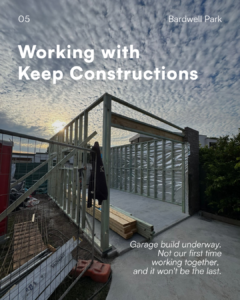
Q1 also included a project that sits slightly outside the modular framework but speaks directly to how the Keep group operates: a garage build at Bardwell Park, delivered in collaboration with Keep Construction.
Keep Construction is the traditional building arm of the group. The relationship between Keep Modular and Keep Construction is not incidental — it is how the hybrid volumetric model works in practice. The Bathurst SDA duplex required both: factory-built modules from Keep Modular, and on-site construction elements from Keep Construction. Bardwell Park is a similar expression of that collaboration, just in a different configuration.
The broader construction industry in Australia is increasingly recognising that modular and traditional methods are not competitors — they are complementary tools. The right question is not “modular or traditional?” but “which parts of this project benefit from factory production, and which parts require on-site work?” The Keep group is structured to answer that question, and to deliver both.
Designing for Every Australian: SDA, Accessibility, and the Forma System
The SDA Robust work at Bathurst sits within a broader philosophy that has shaped the Forma product range since its inception.
The Forma Series — our range of pre-designed modular homes — is not designed to meet minimum standards. Every Duo-Forma product in the series complies with the Livable Housing Australia (LHA) Silver Standard as a baseline. Hallway widths exceed the minimum clear requirement. Internal doors are 900mm throughout — wider than the Silver Standard requires. Hobless showers are standard across every product. Grab rail reinforcing is factory installed in every bathroom.
These are not optional upgrades. They are standard inclusions, built into every product at the design stage, because we believe that homes built for broader accessibility are better homes for everyone.
The SDA work extends this thinking into the more demanding Robust category. A Robust-class SDA home must withstand higher levels of physical impact and be designed around the specific support needs of the resident. Our hybrid volumetric model — factory-built structure and fit-out, with site elements completed by the site team — is well suited to this kind of work, because the factory environment gives us consistent quality control over the elements that matter most.
If you’re a developer, support coordinator, or NDIS participant investigating Specialist Disability Accommodation options in NSW, including regional areas, we’d encourage you to get in touch. This is work we can do.
What Standardisation Actually Means: Duo-Forma and Life-Forma Launched
Q1 2026 also marked the formal launch of two product lines that have been years in development: Duo-Forma and Life-Forma.
These are not marketing names for the same product range repackaged. They represent a structural commitment to standardisation — and an understanding that standardisation is what makes modular construction genuinely efficient at scale.
The Forma system is the foundation. Every module across every Forma Series product is built on the same fixed widths (2,700mm and 3,300mm), the same wall build-up, the same window schedule, the same facade grid, and the same finishes palette. The procurement is consistent. The factory workflow is consistent. The documentation is consistent. When a new product is added to the range, it inherits everything that came before it.
Duo-Forma is our two-module series — secondary dwellings, granny flats, rural housing. The range currently includes four products: a compact one-bedroom (Duo-Forma 01), a standard two-bedroom (Duo-Forma 02), an L-shaped two-bedroom (Duo-Forma 03), and a larger rectangular two-bedroom for rural and acreage sites (Duo-Forma 04). All sit within the 60sqm CDC/Section 68 threshold for standard sites in NSW, with the exception of Duo-Forma 04 which is designed for larger lots where that threshold doesn’t apply.
Life-Forma is our three-module-and-above series — full residential homes, single and double storey, including single dwellings (LFS), duplexes (LFD), and terraces (LFT). The flagship Life-Forma 130 is a three-bedroom, two-and-a-half-bathroom home across seven modules with an integrated garage, designed for sites from 190sqm upward.
Both ranges are designed to work on typical Australian residential sites, with published minimum site dimensions, compatibility with CDC and DA approval pathways, and clear ex-factory pricing. For buyers who want something beyond the pre-designed range, our Bespoke stream offers a fully custom modular path.
Standardisation sounds like a constraint. In practice, it is what allows us to give buyers something traditional construction rarely delivers: cost certainty before you commit.

Keep Design Studio
Q1 2026 also saw the official launch of Keep Design Studio — the architectural and design arm that sits alongside Keep Modular and Keep Construction within the broader Keep group.
The modular construction industry in Australia has a design problem. Too often, the conversation about modular focuses on speed, cost, and efficiency — and design quality becomes an afterthought. Keep Design Studio exists to close that gap. The studio brings architectural rigour to modular work from the earliest stages of a project, rather than fitting design around a system that was built without it.
For clients engaging us on Bespoke or on projects that sit outside the Forma pre-designed range, Keep Design Studio is involved from concept. For the Forma Series, the studio’s work is embedded in the product itself — in the facade grid, the window schedule, the finishes palette, the 2.7m ceiling height that runs across every product.
You can follow Keep Design Studio on Instagram and LinkedIn for ongoing design content, project photography, and thinking from the team.
What Q1 2026 Tells Us About Modular Construction in Australia
The modular construction market in Australia is large and growing. The housing crisis is real. The case for modular construction efficiency in Australia — in cost, speed, and quality control — is well established. But the gap between the industry’s theoretical potential and what individual companies can actually deliver on varied, complex, real-world sites remains significant.
Our Q1 2026 programme — Bathurst, Cringila, Sutherland, Penrith, Bardwell Park, Duo-Forma, Life-Forma, Keep Design Studio — is not a claim that we have solved that gap. It is evidence of how we are approaching it.
If you’re planning a build in NSW — a secondary dwelling on a suburban block, a home on rural acreage, a specialist accommodation project, or a multi-dwelling development — and you want to understand what modular construction can actually deliver on your site, we’d like to hear from you.
Get in touch with the Keep Modular team →
All Forma Series pricing is ex-factory and excludes transport, installation, site works, connections, and council approvals. Duo-Forma products are designed to sit within the 60sqm CDC/Section 68 threshold for standard NSW sites — Duo-Forma 04 is intended for larger lots where this threshold does not apply. Contact us for a project-specific discussion.


Be the first to comment